Kerry, my wife, brought to our attention a great story by our friend and mentor, Bruce Larson, in his book Believe and Belong (Revel, 1982:21). Bruce contrasts two ways of carrying the weight of the world. Statues of both are found in the heart of New York City—a city filled with people trying be bear the world’s weight on Wall Street, at the United Nations and in international NGOs. In front of Rockefeller Center, a statue of the Greek god Atlas portrays one approach. A muscular Atlas strains to carry the cosmos on his shoulders. According to Greek mythology, this task was for him a curse rather than an act of courage.
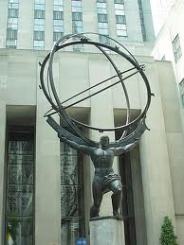

The other statue is found in St. Patrick’s Cathedral across the street from Rockefeller Center. The statue was intentionally placed behind the high altar to contrast with Atlas. It portrays Jesus as a humble young boy effortlessly holding the world in his hands. His hands seemed designed to carry it.
This leads me to reflections I’ve had this week on Gregory of Nyssa’s 4th century sermon on the beatitude, “Blessed are the poor in spirit, for theirs is the kingdom of heaven.” He suggests that poverty of spirit is best understood as “voluntary humility.”
“Unlike every other aspect of God’s nature, which goes far beyond the limits of our nature, humility is something that is natural to us. This is especially true when we take into consideration our humble origins and the uncomfortable fact that when we die, our bodies, which can be such a source of pride in this life, will one day decompose into garden fertilizer…
But don’t think humility is something that can be achieved easily or without practice. Quite the opposite: humility requires more practice and effort than any other highly sought after character trait. Why? Because humility’s opposite—the sin of pride—is deeply engrained in our being…
I want to be clear on this issue: there is no evil that so wounds our soul as pride.” (Gregory of Nyssa, Sermons on the Beatitudes, paraphrase by Michael Glerup (IVP Books, 2012: 27-28).
In Beyond Duty I comment,
“The weight of building the kingdom doesn’t belong on our shoulders. Thankfully, it has been placed on a better set of shoulders—our Lord’s. As soon as we try to shift the responsibility to our own backs, we quickly tumble under the weight of the world. God is building God’s kingdom. The responsibility is God’s. This isn’t merely a semantic issue. This distinction means the difference between something that is life-giving and something that is death-dealing.” (Beyond Duty: A Passion for Christ, A Heart for Mission (2013: 41). Available on Amazon US, UK, India, Canada, Japan, France, Germany, Italy, Spain.)
Rather than focusing on ourselves, the burdens we carry, and the self-preoccupying pride that haunts us, the discipline of “voluntary humility” calls us to shift focus. In Hebrews 12, we are reminded to:
“look to Jesus, the source and fulfillment of our faith…Consider him, who endured such hostility against himself from sinners.” The text note for v. 3 adds: “other ancient authorities read ‘who endured such hostility from sinners against themselves.'”
Jesus, in voluntary humility, endured both our hostility against God and the hostility we have against our very selves. God invites us as we pray to place in Jesus’ hands and upon his shoulders the burdens of our lives and our world. The Spirit invites us to shift our focus off ourselves, and look to Jesus who has not only the weight of the world, but even our hostility against ourselves in his pierced hands.
I’ve been reflecting about our role in the coming of the kingdom of heaven to the brokenness of earth.
Often we hear people suggest that we are called to bring, build or establish the kingdom of God on earth. However, nowhere in Scripture are we told to do this. The bringing of the kingdom is God’s work, in which we have the privilege of participating. Jesus “went through cities and villages, proclaiming and bringing the kingdom of God” (Luke 8:1).
We don’t bring, cause, build or create the kingdom. If we use these terms, we risk taking ourselves too seriously. We risk mission narcissism and even the idolatry of our own effort.
This distinction between God’s work and our own doesn’t minimize the importance of our ministry. Rather, it makes our ministry possible. Jesus invites us to a dynamic and even dramatic way of life and service. We are sent in Christ by the Spirit with the staggering commission “to proclaim the good news of the coming of the kingdom, cure the sick, raise the dead, cleanse and welcome the outcasts, and cast out demons” (Matthew 10.7-8). That high calling is a long way from how I’ve lived. Much of my ministry has occurred behind desks and in conference rooms: managing church, mission and academic programs; preparing sermons and lectures; writing books. Yet I hear in the voice of Jesus God’s call to all of us.
With that compelling (and for most of us, utterly daunting) call, it’s vital to distinguish who does what:
God brings the kingdom. In Christ, by the power of the Spirit, our lives bear witness to it.
God builds the kingdom. We have the privilege of participating in what God is doing.
God provides signs of the kingdom. We are invited to allow God to work in and through us.
Remember as a child being invited to help prepare a party? Or maybe you don’t have to go back that far—we all like to be included in making something wonderful happen. So with us, God and the kingdom. God invites us–each in our own way–to help prepare earth to receive the kingdom banquet.
We are participants in the coming kingdom, not producers of it.
If this participation involves proclaiming, curing, raising, cleansing, welcoming and casting out–it’s no wonder Jesus told us we better wait and ask to receive the power to do this (Acts 1.8). I propose this as God’s invitation as we begin our Lenten journey.
Quotation from Dearborn, Beyond Duty: A Passion for Christ, A Heart for Mission (2013: 40). Available on Amazon US, UK, India, Canada, Japan, France, Germany, Italy, Spain.
P.T. Forsyth’s words ring like a strange song from an imaginary land. Everything in and around us screams out for us to do more, give more, accomplish more. Inadequacy, insufficiency and incompleteness seem to dominate our lives and world. Amidst this tumultuous noise, the Spirit speaks to us the news that “God is good at God’s job, and God isn’t worried about the future of our lives, our families, our ministries or our world.”
“Without confidence in a completely trustworthy God, we are likely to approach our life in the world as an impossible, precarious human enterprise. We’ll feel as though we have tasks and needs that are absurdly unrealistic, and equally absurdly, all up to us…In our longing to see changes occur in our world we are prone to becoming addicted to our own efforts. We live on the brink of breakdown. We relentlessly try to fill the black hole of needs, disasters and emptiness with the limited resources of our over busy lives. We take on more than we can possibly manage and then feel sucked into the holes we were trying to fill. We know this doesn’t work. When we’re honest, we sometimes feel like God isn’t even succeeding at meeting our own needs. There doesn’t feel like there is much left over to give away to the world.”
In sharp contrast to this burdensome way of life, we are empowered by the Spirit to trust the utter reliability and resolute sufficiency of God’s power at work in us and in our world.
Quotation from Dearborn, Beyond Duty: A Passion for Christ, A Heart for Mission (2013: 36-37). Available on Amazon US, UK, India, Canada, Japan, France, Germany, Italy, Spain.
“Many of us specialize in challenging and provoking people into mission by focusing on what’s missing and what’s lacking. Good-hearted people respond with compassion and kindness. We drive ourselves and others into the world with exhortations to: give more, do more, be more, care more, serve more, love more. Though this may provoke some people’s response and involvement, something is missing. How do we live the abundant life of Christ when our entire focus is on deficits and deficiencies?
P.T. Forsyth offered the great insight in his 1908 book, Mission in State and Church: ‘The weakness of much current mission work and much current preaching is that they betray the sense that what is yet to be done is greater than what has already been done.’ Forsyth goes on to say the gospel proclaims that ‘the world’s gravest need is less than Christ’s great victory…The great thing is already done. What needs doing is all less than has been done.'”
Quotation from Dearborn, Beyond Duty: A Passion for Christ, A Heart for Mission (2013:33, 35). Available on Amazon US, UK, India, Canada, Japan, France, Germany, Italy, Spain.
“If we begin with a human-centered approach to “our” mission in the world, we are likely to feel chronically overwhelmed by insufficient resources and insurmountable tasks.
We begin instead with this question: Who is the Triune God and what is God doing in the world?
We don’t next ask the tempting question: What does God want us to do?
That can so quickly redirect us back onto ourselves. Rather we ask: How is God inviting us to participate in what God is doing in the world?
Mission must never have first place in our own or our church’s life. We have but one Lord and one passion, the One in whom all the fullness of God dwells, who has reconciled all things to God (Colossians 1:19-20). If we or the church today are in need of a conversion, it is to Jesus Christ and utter dependence on the Triune God. We must say an emphatic “No!” to lesser gods who clamor for our allegiance, and sing a living and joyous “Yes!” to the One in whom all creation is summed up. “
Quotation from Dearborn, Beyond Duty: A Passion for Christ, A Heart for Mission (2013:29). Available on Amazon US, UK, India, Canada, Japan, France, Germany, Italy, Spain.
“Instead of being people’s shepherd, caring for and protecting them, I have often been more like a cattle herder, shouting, calling and shoving them forward. I’ve been determined to get this herd from Abilene to Kansas City—regardless of the cost. Surely it is God’s will for the church to move out in mission. As a result I’ve often treated people as a means to an end. Rather than embracing them as beloved children of God, I have tried emotionally and spiritually to coerce them into mission involvement. We are idolaters of our effort and impact when we sacrifice people’s dignity and even attempt to sacrifice God on the altars of impact, efficiency and effectiveness.”
Excerpt from Dearborn, Beyond Duty: A Passion for Christ, A Heart for Mission (2013: 25-26)
“To set mission before the church as our reason for existence is to risk focusing our attention on an idol.
At heart, lack of interest in mission is a wound of the heart. Experiences from our past, perceptions of the present, and possibly even lack of emotional assurance of God’s trustworthy love for the future wound us. Some people question whether God is really good and really trustworthy, all the time. The remedy is found in God drawing us into the embrace of God’s tender, all-sufficient love. As our passion for Christ deepens, the passions of his heart become the passions that propel our hearts
We don’t command people to a commitment to a task. We invite people to live in the love of God.”
Beyond Duty: A Passion for Christ, A Heart for Mission (2013: 16-17)
The Spirit shifts our center. We no longer live from the center of our needs, efforts or weaknesses–but from the heart of God–and God”s trustworthy love for us and the world. In Beyond Duty: A Passion for Christ, a Heart for Mission I propose:
“The church does not have a mission for God in the world.
The God of mission has the church in the world.
Or, to put it personally,
We don’t have our own mission for God in the world.
The God of mission has us in the world.
We are participants in God’s mission, not producers of our own.
We are always dependent and never directors.
We live in our own weakness and in God’s strength.”
For more information, visit Dynamis Resources.

Since leaving World Vision International a few months ago, I have had time to revise and republish Beyond Duty: A Passion for Christ, a Heart for Mission. This new edition reflects some of what I’ve learned during my 10 years with World Vision, some of the changes that have occurred in our world, and some of the changes God has brought to my own heart and soul.
My conviction is that our engagement in mission is not a set of tasks, strategic objectives or strenuous obedience to God’s mandate in response to world needs. Rather, it is our joyous participation in the life-giving love and grace of God for the world. This love engenders confident trust and bold hope. In spite of what is proclaimed by the noise of the doomspeakers and naysayers, we live in a world about whose future God isn’t worried. For more information, visit Dynamis Resources. To order from Amazon, click here.
Here’s an excerpt:
“The gospel frees us to live from the center of God’s encompassing love. We needn’t live from the burdensome center of “me”. It’s not about my mission, ambitions, work and weaknesses. We can live as grateful participants in God’s abundant love for the world. In the midst of our obedient service, we can sing and play and not take ourselves so seriously. The news we sing is utterly “good”. We are expressions of God’s great “yes” in Christ. The gospel resounds with the stunning “Yes” of God.
God is in love with us and with all of creation. If God responds with love toward us, can’t we do the same?
God is not mad at us. If the God of justice isn’t mad, what good reason is there for us to be?…
God is good at God’s job of ruling the world. If God is good at God’s job, maybe we shouldn’t try to take over?
And so, God isn’t worried about the state of the world (or of our lives). If God’s not worried about the future of our life or the world, maybe we don’t need to be so anxious?” (pp. 6-7)


 Dynamis Resources