Take the weight off our shoulders
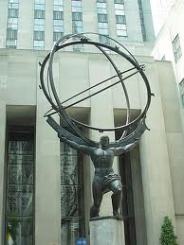
Kerry, my wife, brought to our attention a great story by our friend and mentor, Bruce Larson, in his book Believe and Belong (Revel, 1982:21). Bruce contrasts two ways of carrying the weight of the world. Statues of both are found in the heart of New York City—a city filled with people trying be bear the world’s weight on Wall Street, at the United Nations and in international NGOs. In front of Rockefeller Center, a statue of the Greek god Atlas portrays one approach. A muscular Atlas strains to carry the cosmos on his shoulders. According to Greek mythology, this task was for him a curse rather than an act of courage.
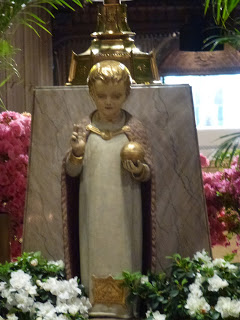
The other statue is found in St. Patrick’s Cathedral across the street from Rockefeller Center. The statue was intentionally placed behind the high altar to contrast with Atlas. It portrays Jesus as a humble young boy effortlessly holding the world in his hands. His hands seemed designed to carry it.
This leads me to reflections I’ve had this week on Gregory of Nyssa’s 4th century sermon on the beatitude, “Blessed are the poor in spirit, for theirs is the kingdom of heaven.” He suggests that poverty of spirit is best understood as “voluntary humility.”
“Unlike every other aspect of God’s nature, which goes far beyond the limits of our nature, humility is something that is natural to us. This is especially true when we take into consideration our humble origins and the uncomfortable fact that when we die, our bodies, which can be such a source of pride in this life, will one day decompose into garden fertilizer…
But don’t think humility is something that can be achieved easily or without practice. Quite the opposite: humility requires more practice and effort than any other highly sought after character trait. Why? Because humility’s opposite—the sin of pride—is deeply engrained in our being…
I want to be clear on this issue: there is no evil that so wounds our soul as pride.” (Gregory of Nyssa, Sermons on the Beatitudes, paraphrase by Michael Glerup (IVP Books, 2012: 27-28).
In Beyond Duty I comment,
“The weight of building the kingdom doesn’t belong on our shoulders. Thankfully, it has been placed on a better set of shoulders—our Lord’s. As soon as we try to shift the responsibility to our own backs, we quickly tumble under the weight of the world. God is building God’s kingdom. The responsibility is God’s. This isn’t merely a semantic issue. This distinction means the difference between something that is life-giving and something that is death-dealing.” (Beyond Duty: A Passion for Christ, A Heart for Mission (2013: 41). Available on Amazon US, UK, India, Canada, Japan, France, Germany, Italy, Spain.)
Rather than focusing on ourselves, the burdens we carry, and the self-preoccupying pride that haunts us, the discipline of “voluntary humility” calls us to shift focus. In Hebrews 12, we are reminded to:
“look to Jesus, the source and fulfillment of our faith…Consider him, who endured such hostility against himself from sinners.” The text note for v. 3 adds: “other ancient authorities read ‘who endured such hostility from sinners against themselves.'”
Jesus, in voluntary humility, endured both our hostility against God and the hostility we have against our very selves. God invites us as we pray to place in Jesus’ hands and upon his shoulders the burdens of our lives and our world. The Spirit invites us to shift our focus off ourselves, and look to Jesus who has not only the weight of the world, but even our hostility against ourselves in his pierced hands.


 Dynamis Resources
Hi Tim. I am the pastor of a church in SC. I have read this story before and wanted to use it, but could not verify the existence of the statue of Christ at St. Patrick’s. Can you verify that the statue you picture here is indeed in St. Patrick’s Cathedral in NY? I can’t find it anywhere else! Thank you my brother!